

In partnership with

Vo. 1, No. 7
Good morning and welcome to another edition of Cus Words Sports!
Ohio State does not have a football game this week, but there is still lots going on. Here’s a bye week edition of Buckeye Historian, my regular attempt to put current events in a historical context for Ohio State.
You have probably heard by now, but in case you missed it: Ryan Day confirmed Tuesday night Ohio State is making plans for Julian Sayin to be out for the rest of the regular season and the College Football Playoff.
Of course, the Buckeyes have to make the CFP to worry about who will take the snaps in that particular event, and getting there will be easier said than done without their starting quarterback, right?
Well, Day, offensive coordinator Arthur Smith and the rest of the staff would surely rather have Sayin back there, but the season is far from over if history is any guide.
Ohio State backup QBs have been remarkably successful in the past
If you subscribe to a newsletter that spends a lot of time on Ohio State sports, you might already be aware the Buckeyes have a history of winning with replacement quarterbacks.
You might still be surprised to know just how much history, though.
Ohio State is 23-2 when a backup or replacement quarterback starts a game going back to the turn of the century:
2003: Scott McMullen went 2-0 filling in for Craig Krenzel
2004: Troy Smith went 4-1 in place of Justin Zwick
2013: Kenny Guiton was 2-0 starting for Braxton Miller
2014: J.T. Barrett was 11-1 starting for Miller
2014: Cardale Jones was 3-0 when Barrett also was injured, and Ohio State won the Big Ten Championship Game and the first College Football Playoff
2021: Kyle McCord went 1-0 when OSU chose to rest C.J. Stroud for a game because of an achy shoulder
That’s pretty good, right? As near as I can tell, that mark goes back a lot farther, though I can’t say I checked every single game so we’ll ride with 23-2 since 2000 if you’re trying to impress your friends at parties, bars or on the internet.
Read less, know more.

That's it. That’s the pitch.
Morning Brew is a free daily email that explains the news shaping your life in a way you won't hate. From how geopolitics hits your wallet to AI eating entire industries, it's all explained in about 5 minutes, with just enough puns to keep things interesting.
Heck, you might even enjoy the news for once. No jargon. No pretending you understood that stock market headline.
See why over 4 million people start their day with Morning Brew.
The unforgettable 2014 season
I still would love to know what a healthy Braxton Miller would have looked like with those players around him because a big theme of that offseason had been letting the two-time Big Ten MVP be more of a distributor, a role J.T. Barrett ended up filling very well1.
Barrett ended up being named Big Ten Freshman of the Year that season and setting 39 Ohio State records during his four-year career. He was inducted into the Varsity ‘O’ Athletics Hall of Fame earlier this year.
His efficiency replacing Miller was impressive — especially after shaking off a rough game against Virginia Tech in week two — and he became a real playmaker in his own right later in the season, especially during wins at Michigan State and Minnesota.
What Jones did was even more stunning after Barrett suffered a broken leg late in a win over Michigan.
The big dude from Cleveland hit Devin Smith with a 39-yard touchdown pass 1:59 seconds into the Big Ten Championship Game to put Wisconsin on notice and finished 12 of 17 for 257 yards and three TDs while Ezekiel Elliott ran for 220 yards in a shocking 59-0 Ohio State win. Then Jones was good enough in playoff wins over Alabama and Oregon for Elliott and the defense to carry the Buckeyes to victories.
I actually wrote something before the season for FoxSports.com about Miller’s injury not eliminating the Buckeyes from contention for the Big Ten title and a CFP berth because of that, though I stopped short of saying they could win it all. I also admit I had no faith whatsoever that Jones would come in and do what he did against Wisconsin or that they would beat Alabama in the Sugar Bowl, but that’s why they play the games!
The legend of Troy Smith is born
Jim Tressel might have eventually gone to Smith anyway in 2004 with the team in a three-game losing streak, but he didn’t do it until Zwick was hurt in the debacle at Iowa.
Smith’s 2004 season sort of became a footnote in the wake of his two seasons as a starter, but it was an interesting experience. He completed 12 of 24 passes for 161 yards in a 30-7 win over Indiana in his first start, including a 59-yarder to fellow Glenville High School alumnus Ted Ginn Jr.
The Buckeyes then won two very Tresselball games leaning heavily on defense and special teams (and Ginn) over a bad Penn State team and below-average Michigan State squad before a dispiriting loss at Purdue. Smith threw three interceptions in West Lafayette, and it seemed like the Buckeyes were headed home for another loss to Michigan the following week.
Then, as former Buckeye Sports Bulletin editor Mark Rea once put it, Smith decided to channel Vic Janowicz out of nowhere. He absolutely torched the 7th-ranked Wolverines for 386 total yards in a 37-21 humiliation for the visitors.
Smith ran for 145 yards, becoming the first Ohio State QB to run for over 100 yards in more than 20 years. He also threw for 241 yards to become the first Ohio State QB to throw for 200 and run for 100 in the same game EVER, and a legend was born. (It was also tarnished by a two-game NCAA suspension for accepting illegal benefits, but that of course looks a lot different given the way things are with compensation today.)
That not only helped set the stage for bigger and better things in 2005 and ’06 when Smith won the Heisman Trophy, it also started a seven-game winning streak in The Game for Ohio State.

The original Super Sub
Guiton not only won two games as a starter in 2013 but relieved Miller multiple times in other games, most notably when the Buckeyes rallied to beat Purdue in overtime to preserve the undefeated 2012 season.
But Guiton is not the most famous Ohio State fill-in quarterback, and Barrett and Jones were not the first to play key roles in a national championship season.
Before them came Ron Maciejowski, who backed up Rex Kern for three seasons and helped the Buckeyes win a pair of national titles and two Big Ten championships from 1968-70.
Maciejowski started victories against Wisconsin in 1968 and ’69 when Kern was injured.
He also led a late game-winning touchdown drive in a 31-24 victory at Illinois in ’68 and set the Buckeyes up for the winning score against Purdue in the penultimate regular season game of 1970. That set up a revenge game victory over Michigan that clinched a trip to the Rose Bowl
(In another twist, Bill Long scored the only Ohio State touchdown in place of an injured Kern against Purdue in 1968 when the Boilermakers were ranked No. 1 in the country. Long had been the starter in ’67 but was unseated by Kern in the 1968 preseason.)
Fresh-Roasted Coffee, Without Leaving the House

A third-generation LA roaster ships 50+ coffees — single origins, flavored favorites, decafs, even teas — days after roasting. Mix and match Keurig®-compatible boxes for tiered savings up to 34% off. First order? Take an extra 15% off, automatically.
Today’s perspective
What does it all mean for today?
Well, not much. Luke Fahey (or maybe Tavien St. Clair) won’t get any extra time in the pocket against USC next weekend because J.T. Barrett handled emergency duty well 12 years ago, but it can’t hurt as motivation, either.
“It’s been done before,” as Ryan Day said Tuesday night.
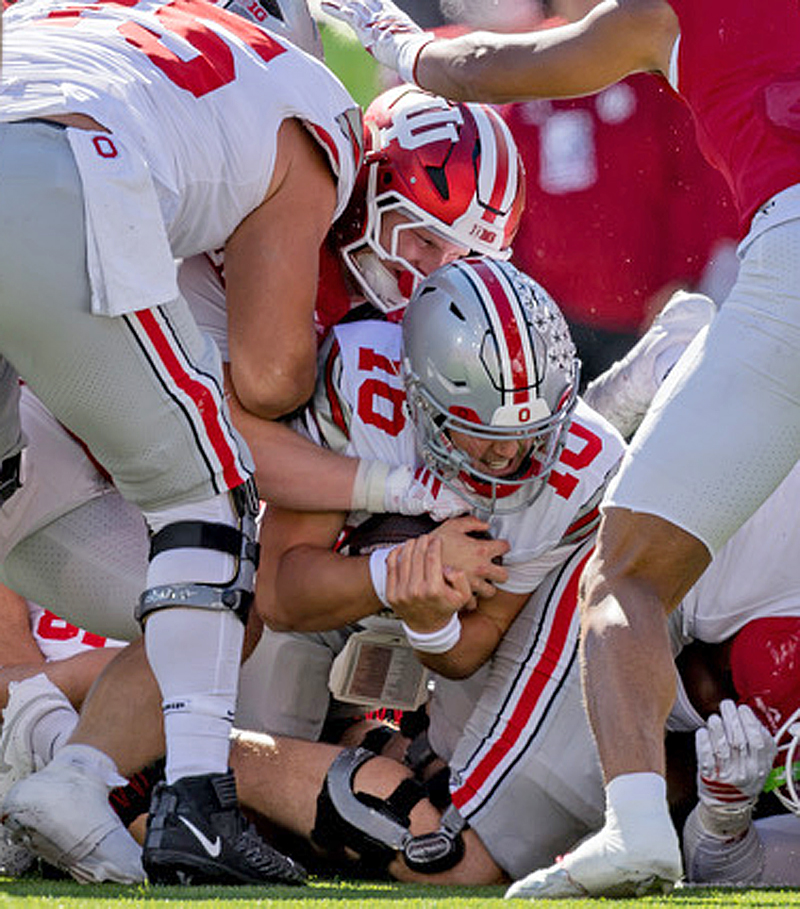
The most instructive part of this exercise is probably a reminder of two things: 1) Ohio State usually wins because it has a lot of good players, be they quarterbacks or at other positions, and 2) success is more likely to be based on what they do.
The story of the 2014 season was as much the emergence of Elliott and an offensive line that was maligned early in the year as well as a defense that found its stride later in the campaign when the defensive line stepped up big time.
That type of thing is going to happen again for Ohio State to be playing in January this season.
The Maciejowski story is also notable nowadays because he would very likely not have stuck around to back up Kern for two more seasons after ’68 if transferring elsewhere not only for playing time but a handsome payday were an option. I spoke with him for a Buckeye Sports Bulletin story this past summer, and he said earnestly he is glad the rules were what they were back then because he probably would have left. He’s happy he didn’t.
That’s all for this edition of Buckeye Historian. There will not be a new Tressel Tales this week, but come back Friday for This Week in Ohio State Football where we round up the rest of the news from this week and further examine where the current Buckeyes go from here based on the quarterback change.
(Like what you see? Please share by forwarding this email, sharing the link on social media or sending someone this link)

Interested in starting your own newsletter? I’m using Beehiiv, and I highly recommend it.
Click here to learn more (and if you end up subscribing, I would get a commission, but it is free to try and to maintain a newsletter).
1 We can argue perhaps that Barrett and Smith became the starters at some point during those seasons, but I am comfortable with this interpretation and it’s my newsletter. Barrett started the season-opener at Navy after Miller went down in preseason practice, but it didn’t really feel like his job until at least the double overtime win at Penn State when he played through is own knee injury or maybe even when they thrashed Michigan State in November. Plus a big part of the folklore from that season depends on Cardale Jones being the No. 3 QB, so this is what we’re going with.